
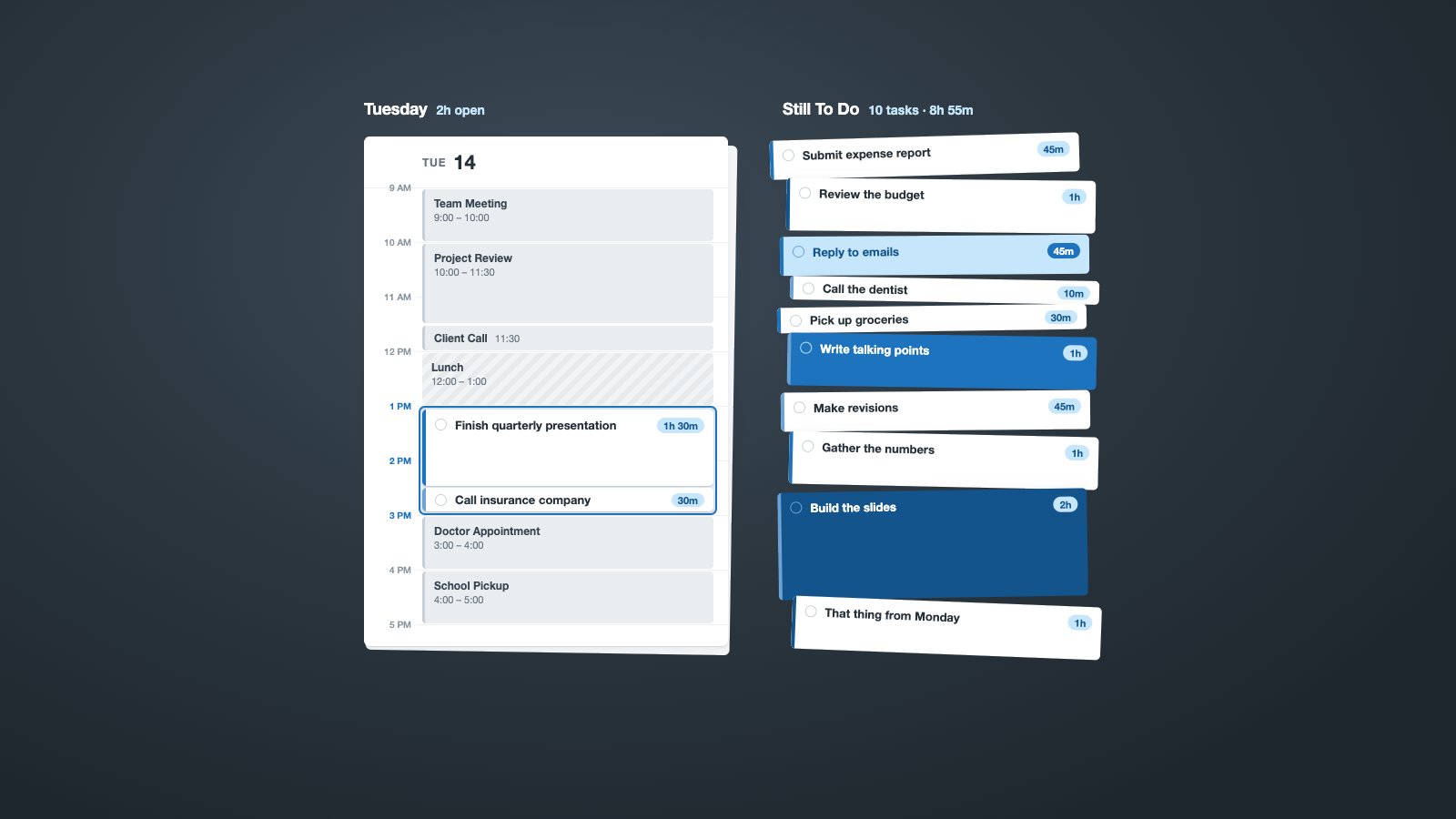
Your to-do list has a serious design flaw: it doesn’t know how long a day is.
You can add 12 tasks to Tuesday without your list objecting.
Finish the presentation. Call the dentist. Review the budget. Pick up groceries. Reply to those emails you’ve been avoiding. Finally deal with that thing you moved from Monday.
It all fits beautifully.
Until you look at your calendar and remember that Tuesday also contains three meetings, an appointment, lunch, and ideally, some portion of your life that isn’t represented by a checkbox.
This is one reason a perfectly reasonable to-do list can leave you feeling behind at the end of the day.
The problem may not be how much you accomplished. You may have simply planned more work than your day could hold.
A To-Do List Measures Work. Your Calendar Measures Time.
To-do lists are great at answering one question: What needs to be done?
They’re not nearly as good at answering another: When am I going to do it?
Imagine you start Monday with these four tasks:
- Finish quarterly presentation
- Submit expense report
- Call insurance company
- Schedule dentist appointment
Four tasks doesn’t sound unreasonable.
But now add time.
The presentation might take two hours. The expense report could take 45 minutes. The insurance call might take half an hour, or considerably longer if hold music becomes your afternoon soundtrack. Scheduling the dentist might take five minutes.
Suddenly, four tasks means more than three hours of work.
And that’s before you account for anything already on your calendar.
This is where daily planning gets more useful. Stop thinking only about the number of tasks you have and start thinking about the amount of time you actually have available.
Start With What’s Already Spoken For
Before deciding what you’ll accomplish today, look at the time you’ve already committed.
Meetings. Appointments. School drop-off or pickup. Lunch. A commute. Anything else that genuinely has to happen at a particular time.
If you have an eight-hour workday but four hours are already committed to meetings, you don’t have eight hours available for the rest of your work.
You have something closer to four. Probably less.
Because humans generally need such luxuries as bathroom breaks, food, transitions between activities, and occasionally staring at a screen for 30 seconds wondering why they opened that tab.
Your calendar gives you something your task list can’t: capacity.
Give Your Tasks a Rough Time Estimate
Now look at what you want to accomplish.
Instead of asking only, “Is this important?” add another question: “How long will this probably take?”
You don’t need stopwatch-level precision.
“About 15 minutes,” “roughly an hour,” and “this is going to eat most of my afternoon” are already much more useful than no estimate at all.
This also exposes tasks that are secretly projects.
“Prepare presentation” may look like one item on a list, but it could actually mean:
- Gather the numbers
- Build the slides
- Write talking points
- Review everything
- Make revisions
That innocent little checkbox may represent three hours of work.
Once you start thinking in time instead of checkboxes, your daily plan becomes much more realistic.
Decide What Actually Fits
Now comes the part many to-do lists conveniently avoid.
Something may not fit today.
That doesn’t automatically mean it isn’t important. It doesn’t mean you’re procrastinating. And it doesn’t mean you failed.
It means Wednesday exists.
Suppose you have three hours available and five hours of tasks you’d like to finish. Something has to move.
It’s better to make that decision at 9:00 a.m. than discover it at 4:47 p.m. while wondering where the day went.
Choose the work that matters most, fits the time available, or genuinely needs to happen today. Then make a conscious decision about the rest.
A realistic list of four tasks can be much more useful than an aspirational list of twelve.
Don’t Schedule 100% of Your Available Time
Here’s where a beautifully organized day can become a trap.
You calculate that you have four hours free, so you schedule exactly four hours of tasks.
Perfect.
Until the 30-minute meeting lasts 45 minutes. An email needs an unexpected response. Your computer updates at the worst possible moment. A “quick question” turns out not to be particularly quick.
Real days have friction.
If your plan requires everything to start on time, end on time, and go exactly as expected, it isn’t much of a plan. It’s a best-case scenario.
Leave some room.
That breathing space gives you somewhere to put the unexpected without forcing the rest of your day into a domino effect.
Put the Two Versions of Your Day Together
At this point, you have two important pieces of information.
Your calendar tells you what has to happen and when. Your task list tells you what you want or need to accomplish.
The useful part happens when you can see those things together.
Instead of looking at an empty space between 1:00 and 3:00 and assuming you’re free, you can recognize that those two hours may already be needed for a task.
Instead of staring at seven unfinished tasks at the end of the day, you can see earlier that only three of them realistically fit around your existing commitments.
This is also where having your calendar and tasks in the same planning system can help.
Pocket Informant is built around that idea. Your schedule and your tasks shouldn’t have to exist as separate versions of your day. Seeing tasks alongside calendar commitments makes it easier to understand what your time is already committed to and what you can realistically take on.
If you’d like to learn more about why the two work better together, read Your Calendar Should Do More Than Show You What’s on Your Schedule.
When the Day Changes, Change the Plan
Your 10:00 meeting ran long. A client called. Your kid got sick. The task you thought would take 20 minutes took an hour.
A good daily plan isn’t one you follow perfectly. It’s one you can adjust when reality shows up.
When something changes, take another look at the remaining day.
What still fits? What still matters? What can move?
This is much more useful than continuing to carry an increasingly impossible list through the afternoon.
Planning isn’t predicting the future. It’s making the best decision you can with the time you have, then adjusting when that time changes.
A Better Question for Tomorrow
At the beginning of the day, many of us ask, “What do I need to get done today?”
Try adding one more question:
“What do I actually have time to get done today?”
That small distinction can change the way you plan.
Your to-do list can contain everything you want to accomplish. Your calendar shows the limits you have to work within.
Neither one tells the whole story by itself.
And if Tuesday only has room for four important tasks?
Maybe four is exactly what should be on Tuesday’s list.
See Your Schedule and Tasks Together
A realistic plan gets easier when your appointments and tasks aren’t living in completely separate worlds. Pocket Informant brings calendar and task planning together so you can see more of your day in one place.



Leave A Comment
You must be logged in to post a comment.