

There is probably something on your calendar that earned its place months ago and has been renewing its reservation ever since.
A weekly check-in. A standing call. A commitment you accepted when your schedule looked very different.
You keep showing up because it is there. But when was the last time you asked whether it still belongs?
A calendar audit gives you a reason to ask. Start with one recent week, look at what actually happened, and decide what deserves space in the next one.
Start with the week you actually had
Open last week’s calendar. Choose a fairly typical week, rather than a vacation or an unusually hectic deadline week.
Then fill in what the calendar missed. Did a meeting run over? Did you spend the gap between appointments answering messages? Did a supposedly quick errand take most of the afternoon?
Your calendar shows what you planned. Your notes can help explain what happened.
You do not need to account for every minute. Write down enough to see which commitments used your time and what they gave you in return.
Ask what each commitment is doing for you
Look at each recurring appointment and ask: What is this time for?
Some answers will be clear. A client call resolved a problem. A school pickup needed to happen. Lunch with a friend was something you wanted to make time for.
Others may be harder to explain. The project ended, but the check-in survived. The update meeting repeated information everyone already had. You attended a call without knowing what you needed to contribute.
For each commitment, consider three questions:
- Does it still serve a current need or priority?
- Do I need to be involved in this form, for this long, this often?
- What would change if we handled it differently?
Personal time deserves a place here too. Rest, relationships, and responsibilities do not need a business outcome to justify their space.
Look for time broken into pieces
A week can contain open time that is awkward to use. A short gap before a call may be fine for one small task, but less useful for work that needs sustained attention.
The American Psychological Association describes research showing that switching tasks adds time costs. That does not tell you exactly how much time your particular schedule costs, but it gives you a reason to notice how often your day makes you change direction.
Look for patterns. Are similar appointments scattered across several days? Does every promising stretch of work end just as you get started?
Where you have flexibility, try moving related commitments closer together. Keep enough room for preparation, travel, and the transition to whatever comes next.
Choose what to keep or change
Give the commitments you reviewed one of four decisions:
- Keep: It still matters and the current arrangement works.
- Shorten: It serves a purpose, but the time or frequency deserves another look.
- Move: It matters, but its placement makes the rest of the day harder.
- Reconsider: Its purpose is unclear, outdated, or better handled another way.
If other people depend on the appointment, discuss the change with them. A useful question is, “Could we try a shorter check-in next week and see whether it still covers what we need?”
You do not have to rebuild your whole schedule. Start with one commitment you can reasonably adjust.
Give the reclaimed space a purpose
Here is a hypothetical example: You have a weekly hour-long project call. The project is nearly finished, and the remaining discussion is a brief status update. You agree with the group to try a 30-minute call next week.
What should happen to the other half hour?
Perhaps it becomes preparation time for your next appointment. Perhaps it gives you room to finish a piece of work or take lunch without rushing.
Choose deliberately. If you hoped to make room for something important, give that activity a place before accepting another invitation.
If the shortened call does not work, adjust it again. Treat the change as an experiment, not a permanent rule.
Review your calendar and tasks together
When you review a commitment, look at the work around it too. A short appointment may involve preparation beforehand and follow-up afterward.
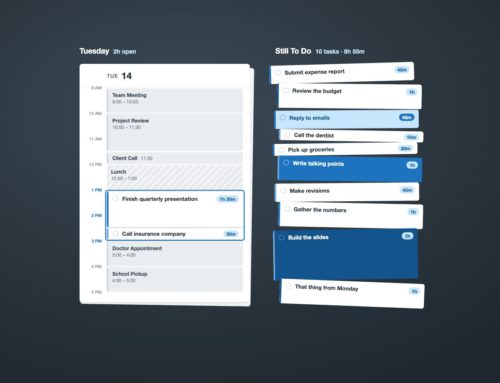
Pocket Informant brings calendar and task planning together, so you can consider your appointments alongside the things you need to do. That makes it a useful place to carry out this review yourself.
For more on that connection, read Your Calendar Should Do More Than Show You What’s on Your Schedule.
Try one change next week
Before you close your calendar, complete this sentence:
“Next week, I will change ______ so I have room for ______.”
Make it specific enough to act on. Then look back at the end of the week and ask whether the adjustment helped.
Your calendar holds real commitments. A regular review helps you notice when those commitments need to change.
Want to review your schedule and tasks in one place? Explore Pocket Informant.
See Your Schedule and Tasks Together
A realistic plan gets easier when your appointments and tasks aren’t living in completely separate worlds. Pocket Informant brings calendar and task planning together so you can see more of your day in one place.



Leave A Comment
You must be logged in to post a comment.